
This story highlights the dedicated work The City of Ottawa is doing to transform culture in LTC moving away from a medical/institutional model of care. Leaders from The City of Ottawa are members of the Champlain Region Person-centred care (PCC) in LTC Community of Practice. Learn more about the provincially expanded Person-Centred Care in LTC Community of Practice.
Social models of care support long-term care (LTC) homes in transforming the home’s culture to prioritize resident quality of life and individualized care and shift away from a traditional, institutional approach. But what if one model didn’t quite suit the needs of your LTC home? What if you could forge your own path and build a model that was the best fit for your LTC home and community?
The City of Ottawa (The City) has been doing just that – designing a culture change model over the past three years to meet the needs of everyone who lives, works, and visits in their homes and their broader community. The Ontario CLRI team was interested to learn more about The City’s custom approach and were delighted to sit down with an incredible group of people who are contributing to this work.
The City of Ottawa owns and operates four LTC homes: Carleton Lodge, Centre d’accueil Champlain, Garry J. Armstrong, and Peter D. Clark. The Ontario CLRI at Bruyère Health had the pleasure of meeting with Natalie Steckly, Strategic Support Coordinator for LTC Services and team members from Carleton Lodge, Yves Pilon, Acting Administrator, Samantha, Person-Centred Care (PCC) Champion, and Carol, Person-Centred Care (PCC) Champion.
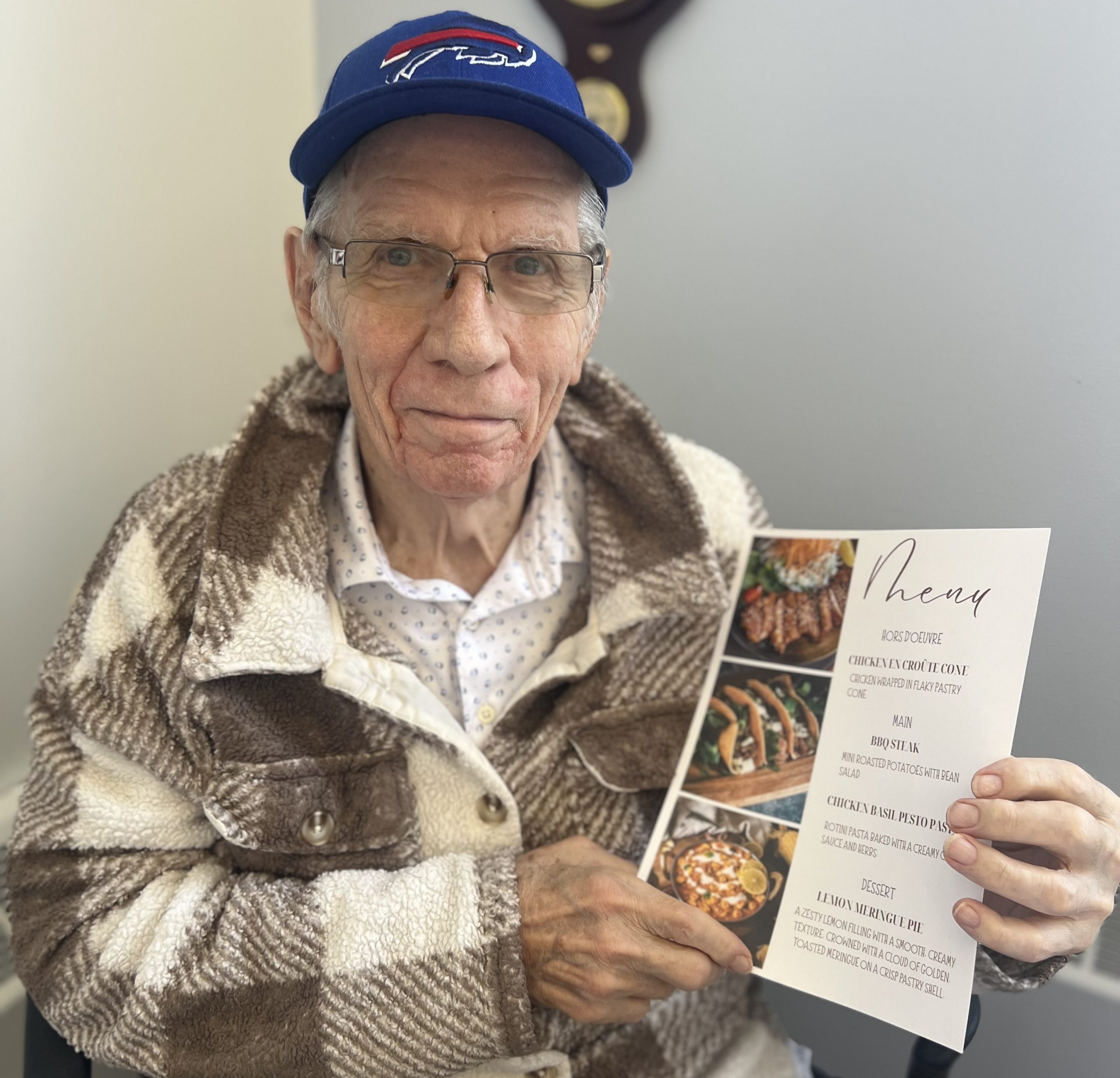
Richard, a resident at Carleton Lodge, holding the menu for a special dinner being served at the home.
The journey began in 2021 under the leadership of Sheila Bauer, the City’s former (now retired) Administrator for LTC Services. Sheila was dedicated to person-centred care and culture change in LTC and was an active member of the Champlain Region Person-Centred Care Community of Practice, a network of LTC homes and partner organizations. This network was started by the Champlain Dementia Network, with support from the Ontario CLRI at Bruyère Health and regional partner organizations, and provided a space for LTC homes to learn about different social and transformative models of care. During this time, The City of Ottawa was developing a new strategic plan and person-centred care became a part of their strategy.
The City began their work focusing on engagements with residents, caregivers, team members, and sector partners and extensive research on established social models of care. The City also conducted focus groups and surveys. The main findings from these engagements included:
- Residents wanted more meaningful activities that were individualized
- Team members wanted more meaningful work
- Advocacy groups thought the specific model of the PCC initiative wasn’t important
- Main priorities that emerged for improving the quality of life of residents: Meals (quality of food, dining experience), Physical Environment (resident rooms, shared spaces), Relationships, Technology, and Recreation (meaningful activities)
After completing their preliminary research, the decision was made to develop a custom approach that moves away from the medical/institutional model and is centred on the residents and their needs. Natalie shared, “It was important to us that our plan reflected the diversity of our residents, families, and team members – every home is different, every neighbourhood is different, so [we wanted] to honour that individuality.” Before rolling it out, Dr. Linda Garcia and uOttawa Life Research Institute developed an evaluation framework and measured a six month pilot period of one neighbourhood at two different homes. In that short amount of time, the evaluation showed that The City’s PCC approach was having a positive impact on residents, families, and team members.
The City started a Steering Committee and each LTC home established an Advisory Committee to represent key partners in their LTC community. The committees bring together different perspectives, with members including residents, team members, families, administrators, external partners from the region, the Regional Geriatric Program of Eastern Ontario, Champlain Region Family Council Network, Ottawa Senior Pride Network, and researcher Dr. Linda Garcia. The Advisory Committees (at the LTC home level) are the operational decision-making bodies under the Steering Committee and provide guidance and support for the PCC Champions. Natalie attributes a significant part of the City’s success so far to the PCC Champions. She explained, “The PCC Champions have worked really well. They are the reason PCC works in all the homes. They are so person-centred, it’s just in their DNA. They know how to work with team members, they know what residents need, they know what needs to be done and how to get the best out of their colleagues.”
What exactly are PCC Champions and what do they do? The Champions implement the PCC initiatives guided by the Advisory Committee at the home level. Champions complete DementiAbility™ training and team training related to culture change, conflict resolution, and coaching. They help support, coach, and manage ongoing challenges with culture change. Team members who are interested in becoming a PCC Champion apply to the job postings and undergo a formal interview process. The City used existing funds from the Ministry of Long-Term Care and not additional funding for these positions. Samantha and Carol were both working as PSWs before transitioning to their PCC Champion roles, so they already had relationships with residents, caregivers and team members.

The table is set for a special meal, requested by residents.

Peter (resident) and Lexi (team member) enjoying a dance.
A main part of the Champion role is coaching team members. Champions fluctuate their schedules so they don’t just work day shifts on weekdays. They come in on weekends, during night shifts, they come in where the need is and support team members.
Samantha explained, “Coaching is a lot of asking the questions and having team members critically think about the solutions themselves and as a team. I’m not their manager – I’m just there to help coach them into different solutions that we can come up with together – things that make them feel heard and have their input come into the solutions.”
Leading huddles with team members is also a key component of the PCC Champion role. Carol said “At the end of every shift, we meet with team members in the neighbourhoods and do a huddle. I’ll do a roundtable of things that went well that day and things that didn’t, so they know they can voice their concerns or opinions and then we guide them and take it day by day.”
The PCC Champions also meet weekly with Natalie and have coaching circles to discuss challenges, what’s happening, and work through things together.
Collaboration is at the forefront of the City’s culture change journey. Samantha told us, “It’s all the collaboration we do with our family members and the different departments. We collaborate and work as a team with the common goal of having the residents live their best lives.” The PCC Champions collaborate with the recreation team on planning large and small group events and individualized activities to give residents positive experiences. The home Advisory Committees also work together to influence change at the home level. For example, the Advisory Committees developed the “Getting to Know Me” form that is posted outside of each resident’s room. The Advisory Committees also co-designed with team members a visual Kardex, which is a resident care information sheet.
The City’s approach provides a unique opportunity for all four homes to collaborate and support each other. Yves explained, “Carleton Lodge and all the homes throughout the City are going through these changes at the same time, and we are learning and sharing what’s working and successes across all four homes – sharing challenges and how one home may have overcome something that another home can learn from.” The home Advisory Committees and the PCC Champions meet regularly to ensure that the work being done at each home aligns with their strategic goals.
In addition to the “Getting to Know Me” forms and visual Kardex, there are a few other PCC initiatives that The City has been working on over the first year and a half of implementation. Carleton Lodge showed us the personalized doors that residents got to choose for their rooms. The home has a PCC information board with resources, including Person-Centred Language, which team members complete training in. The City is also implementing flexible roles for PSWs, to have them engage with residents in different ways, including artwork, making bread, and playing cards. As Natalie put it, “It’s everybody’s job to make residents’ lives better.”

Team members Jerry and Yvon entertaining residents with their guitars.

The Person?Centred Care Champions set up a lemonade stand for residents to enjoy.
The City has been working on waking up naturally and enhancing meal-time experiences – two priorities identified in surveys with residents and key partners. Waking up naturally is exactly as it sounds – residents wake up when they are ready. Carol told us, “Waking up naturally is working really well and it makes the staff feel less rushed. At first it was hard because there was a whole list of tasks, but now every morning is different, and we find the mood of the residents is that they are happier because they are better rested.” To enhance meal time, Carleton Lodge occasionally hosts “Chateau Carleton” at the home. This initiative provides residents with the opportunity to dress up and have a meal like they would at a restaurant. Team members dress in black and white, they have menus that residents can choose their dinner from, and the home has even had a harpist play music.
The City is continuing to implement their PCC initiatives through a phased approach. There are nineteen neighbourhoods at all four homes and they’ve already begun implementing at thirteen neighbourhoods. Each neighbourhood is at a different stage and PCC looks a little different at each home – and that’s okay. The homes are prioritizing doing their work thoughtfully and patiently in manageable steps. Culture change takes time, and as Carol reflected, “It’s a long process and you can get frustrated, but now we get to see how happy the residents are. Sometimes staff think PCC is additional work for them but it’s not, it’s how they do the work. We have to remind them and coach them on that.” Carleton Lodge also prioritizes celebrating successes. Samantha said “It’s a team and we acknowledge them and every day we praise them for the work they are doing. Even if it’s something small, it keeps them going with a positive mindset and the willingness to keep the initiative going.” The City is working toward having their PCC approach implemented in all home neighbourhoods by the end of 2025.
CBC news article: https://www.cbc.ca/news/canada/ottawa/ottawa-expands-project-to-make-long-term-care-centres-feel-more-like-home-1.7332598 Zanbergen, R. (2024, Sept 25). Ottawa expands project to make long-term care feel more like home . CBC Listen
Some additional reading about the City’s journey:
https://ottawa.ca/en/city-hall/city-news/newsroom/lasting-impact-advocating-person-centred-care
Take a look at our other culture change initiatives and stories happening with other LTC homes in Ontario:
- “‘I see it, I see it happening here’ and that felt really good.”: How Osgoode Care Centre’s Eden Journey is Changing Culture
- Empowering Life Stories, Connection, and Individuality: The Glebe Centre’s journey of becoming a Butterfly LTC Home
Written by: Rachel Lithopoulos, Knowledge Broker, Ontario CLRI at Bruyère Health and Michelle Fleming, Senior Knowledge Broker, Ontario CLRI at Bruyère Health.